
 A few weeks ago, I wrote a post titled “User Stories in Agile Marketing“. I intended to write a follow on post the next week, but travel and work and a few other blog posts came in between. Here is the long promised follow on, which covers how development user stories and agile marketing user stories differ, and how to implement user stories in agile marketing.
Here is a table of some of the differences between user stories used for development, compared to those used for agile marketing:
|
Development User Stories |
Marketing User Stories |
| Low level | High level |
| Lots of them | Relatively few |
| Left brain | Right brain |
| Focus on functionality | Focus on outcomes |
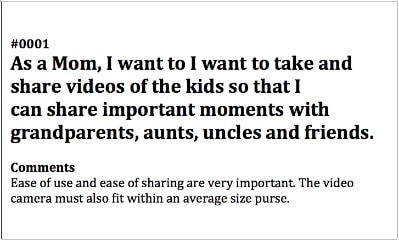
Because development user stories focus on relatively low level details and functionality, there tend to be lots of them in any given project: at least 20-30, and sometimes hundreds. Agile marketing user stories are higher level, and typically, there are fewer of them: generally under 10 per persona, and often only 3-4 per persona. Development user stories tend to focus on left brain oriented processes and functionality, “I want to login so that I can access subscriber content”. Marketing user stories tend to focus on right brain outcomes which have emotions associated with them. “As a mom, I want to take and share videos of the kids so that I can share important moments with grandparents, aunts, uncles and friends.” As marketers, we sometimes focus too much on function/feature, rather than outcomes. Good marketers and salespeople have learned this lesson. How does the Nordstrom saleslady sell a dress? Not based on feature/functions (it has spaghetti straps, a street length hem and six buttons), but based on outcomes (You look great in that dress. Your husband is going to love it).
The back of the card containing a development user story outlines the test cases for the implementation of the user story. When documenting marketing user stories, I use the back of the card for a different purpose. In one column, I list the SEO keywords associated with the user story. This reminds me, if I’m generating a piece of content to address the user story, of the keywords and phrases that I need to incorporate in to my text. In the second column, I list the alternatives that the user has to address this user story, starting with how they address it at present. This column represents the competition, but it’s important to list more than just formal competitors (other companies in your market). How does the user achieve the outcome at present? In the example above, perhaps the mom uses a traditional camcorder to record videos of the kids, or perhaps she doesn’t record video at all, but uses a digital camera and shares stills.
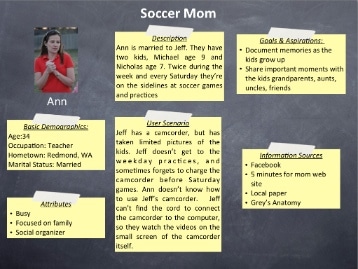 So how to get started using Agile Marketing user stories? Begin by documenting the personas relevant to your product or service. I use a template like the one pictured above (this is a slight modification of a template used by Todd Warren and his NUvention class; thanks, Todd). After I document my personas, I begin writing down user stories for each one of my personas. At times, there is overlap – multiple personas want the same outcomes. But often, different personas in a market or a sales cycle want different outcomes. By documenting these user stories as a team, including the SEO keywords and the alternative solutions, we can be more consistent and more effective.
What’s your experience? Have you tried user stories in marketing? If you’re interested in doing so, and you’d like to start with my templates, leave me a comment and I’ll send them to you.



Hi Jim,
I’ve used user stories before to identify the target market but never been as detail oriented as you are. Love the concept of adding the SEO keywords already at this stage. Does this mean you do your keyword research before User Stories or at the same time?
Would love to get your templates by the way.
Hi Jim,
I’ve used user stories before to identify the target market but never been as detail oriented as you are. Love the concept of adding the SEO keywords already at this stage. Does this mean you do your keyword research before User Stories or at the same time?
Would love to get your templates by the way.
Eric,
I research key words before User Stories generally, but sometimes writing User Stories gives me ideas for new key words. I’ll send you the templates via email.
-Jim
Hi Jim,
This is so exciting. Love the information shared! I would love to receive your templates and try them out!
Thanks Barb. The user stories template is at https://agilemarketing.net/download/2043/ Other downloads can be found at https://agilemarketing.net/downloads/
Hi Jim, I would really appreciate it if I could get a copy of your user story template. However, when I try to download it, I get an HTTP 500 error. Is there another way to access it? Thanks!
It’s at https://agilemarketing.net/download/2043/
Eric,
I research key words before User Stories generally, but sometimes writing User Stories gives me ideas for new key words. I’ll send you the templates via email.
-Jim
Hey, Jim! Love the structured approach to personas. It gives just enough detail to be useful, and not so much as to be overwhealming. I would love a copy of thos templates as well.
Hey, Jim! Love the structured approach to personas. It gives just enough detail to be useful, and not so much as to be overwhealming. I would love a copy of thos templates as well.
Hi Jim, I would also appreciate a copy of the templates. Great post. There are not a lot of user story examples. Thanks for sharing. I found this template from hubspot also, that has provided some guidance in this area. https://www.hubspot.com/Default.aspx?app=LeadgenDownload&shortpath=docs%2fSample+Sprint+Template+by+HubSpot.xls
Hi Jim, I would also appreciate a copy of the templates. Great post. There are not a lot of user story examples. Thanks for sharing. I found this template from hubspot also, that has provided some guidance in this area. https://www.hubspot.com/Default.aspx?app=LeadgenDownload&shortpath=docs%2fSample+Sprint+Template+by+HubSpot.xls
Hi Jim. I have recently moved to the Marketing world from IT(where I used Agile for many years) and am attempting to introduce Agile concepts here, but we are struggling to get the correct level of detail in our user stories. I would really appreciate a copy of your templates please.
Hi Jim. I have recently moved to the Marketing world from IT(where I used Agile for many years) and am attempting to introduce Agile concepts here, but we are struggling to get the correct level of detail in our user stories. I would really appreciate a copy of your templates please.
Orla, I’ve just sent you a template. Have you read my latest post on User Stories as well? I’ve tried to add more detail to the process.
Orla, I’ve just sent you a template. Have you read my latest post on User Stories as well? I’ve tried to add more detail to the process.
Jim-
Great post. I’d love to see a copy of your user story template and what you capture. Thanks!
Pingback: How to Write Agile Marketing User Stories
Pingback: How to Write Agile Marketing User Stories
One thing that I am finding hard to understand is that user stories appear to be just customer (user) archetypes. However, when I look at the Hubspot Sprint template the user stories are of the marketers themselves:
Blog Content Creation | As a HubSpot Marketer, I need to contribute 3 blog articles per month that each generate 1,500 page views or more.
-Brainstorm Topics
-Write posts
-Promote in Social Media
I’m not sure how the creation of this user story in this case helps you to build out your agile sprint. For example, if my team was creating a landing page for a new release a user story would make sense. This would make sure the marketing team actually has an understanding of who the audience is.
However, I’m still a little confused by the above example. Perhaps Jim you can shed some light on this?
Sean,
Great question. User stories are things to be done by user personas (or archetypes). I’m not a fan at all of the HubSpot example you cite. I think it’s a misuse of the user story. However, I do think it’s fair game to write user stories for internal customers, as well as external audiences. For example, “As a HubSpot salesperson, I need a ROI calculator so that I can close more business and earn more commission”. Then, as a marketer, I could write this. Even better would be a user story from the customer’s point of view: “As a CFO, I need an ROI calculation specific to my business circumstances so that I can determine if the expenditure on your product is worthwhile, and I can justify it to the CEO”
I hope that helps.
One thing that I am finding hard to understand is that user stories appear to be just customer (user) archetypes. However, when I look at the Hubspot Sprint template the user stories are of the marketers themselves:
Blog Content Creation | As a HubSpot Marketer, I need to contribute 3 blog articles per month that each generate 1,500 page views or more.
-Brainstorm Topics
-Write posts
-Promote in Social Media
I’m not sure how the creation of this user story in this case helps you to build out your agile sprint. For example, if my team was creating a landing page for a new release a user story would make sense. This would make sure the marketing team actually has an understanding of who the audience is.
However, I’m still a little confused by the above example. Perhaps Jim you can shed some light on this?
Sean,
Great question. User stories are things to be done by user personas (or archetypes). I’m not a fan at all of the HubSpot example you cite. I think it’s a misuse of the user story. However, I do think it’s fair game to write user stories for internal customers, as well as external audiences. For example, “As a HubSpot salesperson, I need a ROI calculator so that I can close more business and earn more commission”. Then, as a marketer, I could write this. Even better would be a user story from the customer’s point of view: “As a CFO, I need an ROI calculation specific to my business circumstances so that I can determine if the expenditure on your product is worthwhile, and I can justify it to the CEO”
I hope that helps.
Hi Jim – just discovered your blog after listening to a presentation by Scott Brinker. We are getting our feet wet at ConceptShare with agile marketing. To be honest we are struggling with it a bit. To be expected when implementing a new process/approach. Would greatly appreciate it if you could share the templates you mentioned above.
And thanks for all of the great content on this blog.
Nish, Scott Brinker is one of my heroes and the original impetus for me to start blogging about Agile Marketing. You can download the templates under Resources, templates on the site.
Great article! We’d love to get the template if you’re still sending them out.
Thanks!
Emily, glad you liked the post. I’ve created a new page under resources that has downloads. You can download multiple templates from that location. Enjoy!
Hey Jim,
Great post. If the marketing team is driven by key metrics related to Acquisition, Activation, Retention, Referral and Revenue – then I prefer the Hubspot example as the story is directly related to the marketing strategy/tactic which is being experiemented with.
The example in the image at the top of the post seems to be a development user story.
”As a mom, I want to take and share videos of the kids so that I can share important moments with grandparents, aunts, uncles and friends.” The outcome says nothing about a desired marketing objective, or does it? (this to me would lead to a development task for the development sprint.) How is this tied to a marketing tactic – maybe to reach a referral objective? Not sure.
I think I am missing something and would love to see examples of real marketing user stories related to tasks that would drive new signups (blogging, social media sharing, PR’s, email marketing). Do you have examples of this?
As of now, we build our sprint backlogs with internal users in mind, but with non-vanity metrics goals considered – example of a key metric: achieve an increase of 10% growth in free sign ups per week. So the backlog entry for a content tactic becomes:
”As a content marketer, I need to create 4 pillar articles for the blog and distribute on our 4 social platforms and via email newsletter to attract 40 new free sign ups per article ”
This becomes an actionable task to assign storypoints to.
I’d love your point of view. Also, your response to Sean seems like it’s missing the example after ”Then, as a marketer, I could write this…”
And the link to the hubspot page isn’t working for me.
Regards
Jonathan (Offerchat.com)
Jonathan, great comments. I see you’re a fan of Startup metrics for Pirates (AARRR!).
Yes, you’re right, the user story listed is a product development user story. An example of a marketing user story would be something like this: let’s say that you’re updating the home page of your web site, and one of the personas you’ve identified as relevant to your business is the “technical evaluator”, someone who evaluates your technology from a feature/function and adherence to certain specs point of view. You might write a user story something like “As a technical evaluator, I want to be able to see within 5 seconds what differentiates your product from the competition so that I can determine if you’re a fit for my preliminary list of candidates”. You would then design the home page of your web site to meet that need. Here’s another example. Let’s say you’re a marketer for REI, the outdoor equipment company, and you’ve identified as one of your personas the “hiking enthusiast”. You might write a story something like “As a hiking enthusiast, I want to capture and share significant moments with other like-minded hiking enthusiasts”, and then you’d go on to design something like REI’s microsite they call the 1440 project https://www.rei1440project.com/ or perhaps create an instagram page, and your acceptance criteria might revolve around the number of positive comments on social media about the project. Or perhaps you write user stories from the point of view of your sales staff: “As a sales person for XYZ company, I need an ROI assessment tool so that I can prove to our customers the return they can expect from investing in our products”. I don’t like writing user stories from the marketers point of view. I think it misses the point. It would be like writing a development user story from the software developers point of view. I hope that helps.
Which Hubspot page link?
Jim
That helps alot. Thanks. I’ve had some trouble lining up user stories with marketing metrics. We follow the idea that every person on the team owns a growth metric (not a vanity metric) and selects tasks to help them reach the goal. We have our personas defined which helps us mostly focus our content creation. In short, we’ve combined AARRR metrics, with Agile Marketing and the practice of every team member owning a metric (from Traction – Gino Wickman)
For us ”traffic growth” is a vanity metric, and ”% growth in absolute signs ups” is a growth metric. With so much overhead in planning and closing sprints, I find that writing user stories for the marketing sprints is an extra step. In development sprints, I see the value.
Maybe with more reading and experience, I will see the value – but as a scrappy startup, our marketing sprint tasks are directly related to the growth metrics we’ve agreed on as a team. We also let the team members select their own tasks to help them reach the metrics goals (still in experimental phase).
Some of the biggest challenges come from the overhead in time planning and closing the sprints. With all the talk about quick experiments, learnings and adaptibility – writing user stories for marketing from the personas standpoint is like assuming they know what they want. Why not just experiment and create the tasks with the metric in mind, rather than the user.
In the example above with REI, the metric would be to increase the referral rate of existing customers or social reach, for example. The marketer in charge of that metric would propose ideas – Build out social photo microsite.
For the dead link, I was referring to the link added by Marti above – but then I found a similar link on your resources page.
Great blog – I’d love to hear your points of view on running agile marketing teams in startups vs running agile marketing in corporate settings. Alot of available content online is not around fast moving startups. Just an idea!
Jonathan
Similar to Orla, I am from the IT side and am looking to help the Marketing team move toward Agile. I would like a copy of your templates if you are still distributing them via email. Or if there is a link to access.
Pingback: Agile Marketing - User stories to drive inbound marketing | Agilis Digital
Pingback: What is Agile and what are user stories | Agile and user stories
Would love the template for marketing user stories. It’s 2015 but we still need it. 🙂
I would like a copy of your user story templates if they are still available. (btw – I just finished reading your free ebook on Agile marketing and it didn’t seem to address user stories at all.) A more interesting adventure will be on how to map user stories to marketing tasks – one of the key aspects of the agile development process…
Great blog post! Would love to get your templates if you’re still sending them out. Thanks!
So, like a User Scenario as opposed to User Story but even more focused on acceptance criteria that are psychological or emotional, i.e., the goal of that ‘piece’ or marketing…(?)